One Clapham
Junction
One Clapham Junction is a residential development in the heart of south-west London, bringing contemporary homes to one of the capital's best-connected neighbourhoods.
Developed by Mount Anvil and Peabody, the scheme forms part of the final phase of the regeneration of St John's Hill, a former 1930s Peabody estate in Battersea.
The development introduces 307 new homes across six distinctive brick buildings, with a mix of apartments, landscaped gardens, communal spaces and amenities designed around modern city living.
Its location is central to the proposition.
Just south of the Thames, with Chelsea and Fulham across the river, Clapham Junction sits between the established neighbourhoods of Battersea, Wandsworth and Clapham. The area combines the character of a London village with independent shops, restaurants, green spaces and a strong sense of local community.
At its centre is Clapham Junction station, one of Britain's busiest railway interchanges, connecting residents to central London, the wider South East and destinations beyond.
One Clapham Junction sits just a minute from the station, placing residents at a pivotal point between the neighbourhood on their doorstep and the opportunities of the wider city.
The challenge was to create a distinctive residential brand that captured both sides of that experience.

Location is one of the most familiar selling points in residential property marketing.
Developments regularly promise excellent connections, vibrant neighbourhoods and the best of city living. But when everyone makes similar claims, even a genuinely exceptional location can become difficult to distinguish.
For One Clapham Junction, connectivity wasn't simply another benefit. It was fundamental to the experience of living there.
Few London neighbourhoods offer such immediate access to a major transport interchange while retaining the independent character and everyday appeal of an established residential community.
Residents could enjoy the cafés, shops and green spaces around them, while knowing that the rest of London was only a short journey away.
We saw an opportunity to bring these two qualities together.
Rather than presenting the development as a collection of apartments near a station, we wanted to position it as a starting point for everything the area and wider city had to offer.
The challenge was to make that sense of possibility feel distinctive, turning the development's physical location into a compelling brand idea.

We built the brand around the proposition A Destination That Transports You.
An idea that captures the dual appeal of One Clapham Junction: a desirable place to call home and a point of departure to the wider city.
Rather than treating the nearby station as a functional benefit, we used the familiar visual language of travel and navigation as the foundation for the identity.
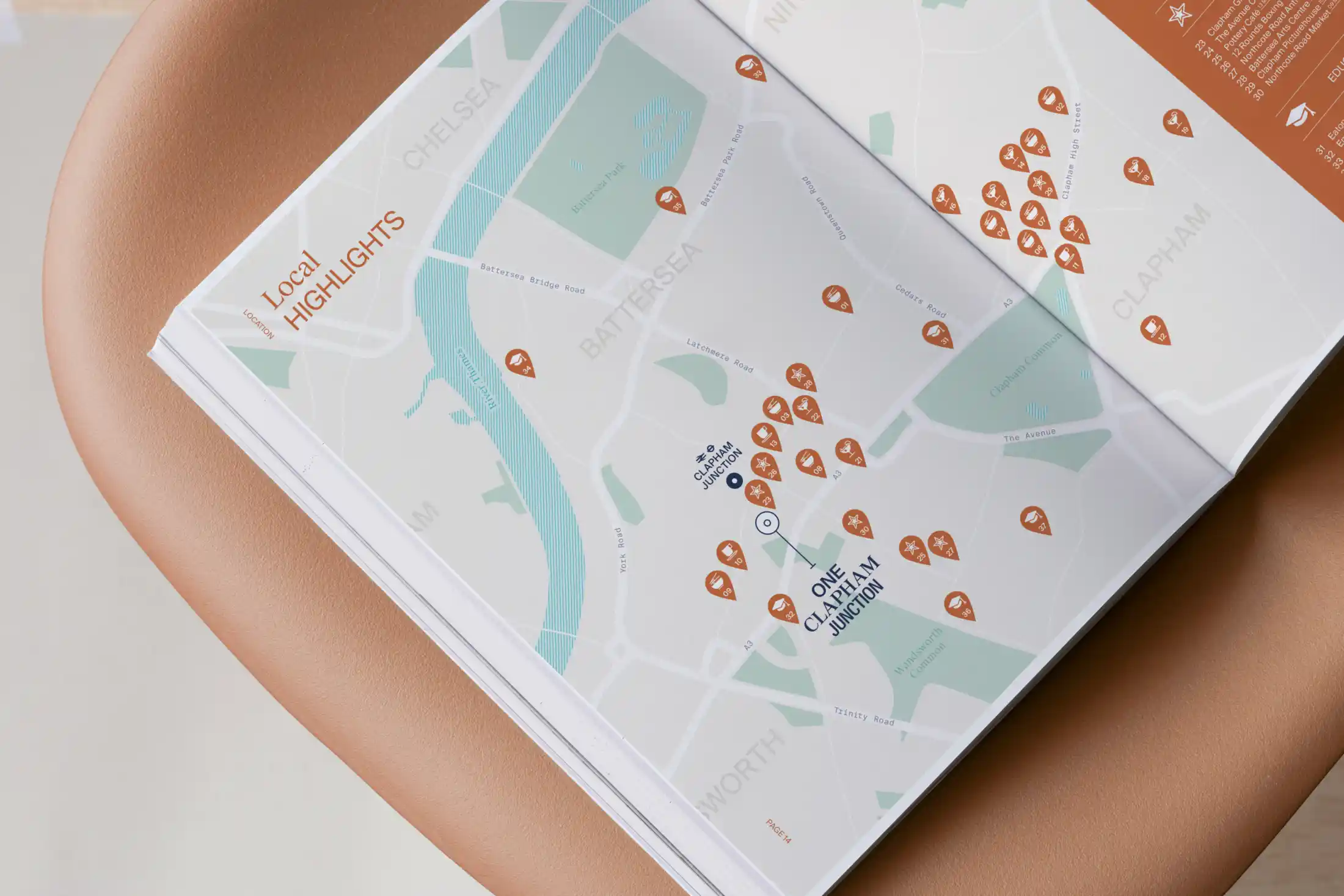
We drew inspiration from the graphic systems people encounter when moving through a city: transport signage, directional symbols, maps and wayfinding typography.
These references gave us a recognisable visual language that could communicate movement, connection and discovery while creating a distinctive personality for the development.
We developed a graphic identity that combines typography with a collection of navigational icons, using the familiar codes of wayfinding in an unexpected residential context.
The elements work together to guide the audience through the development's proposition, connecting the homes with the surrounding neighbourhood and the destinations within easy reach.
The identity brings a sense of movement to the communications, reflecting the experience of living somewhere with so many possibilities on its doorstep.
Rather than relying on conventional luxury property cues, the approach celebrates what makes One Clapham Junction genuinely distinctive: its position within the city.
The brand and campaign turn the idea of a journey into an invitation to explore, encouraging prospective residents to discover both the development and the neighbourhood around it.
The result is a residential identity that transforms a practical location advantage into a more engaging and memorable proposition.
A home that's not simply well connected, but connected to more of what London has to offer.
